
Waiting 40 minutes at a bus stop in the middle of a brutal Canadian winter with the windchill at -20°C is a rite of passage for most international students. After a few months of shivering in the snow and carrying heavy groceries on public transit, almost every student comes to the exact same conclusion: “I need to buy a car.”
The excitement of buying your first vehicle in Canada is thrilling. You browse online, find a sleek, used Honda Civic or Toyota Corolla, and walk into the local dealership. The salesman is incredibly friendly, tells you not to worry about your student status, and promises to get you approved for financing.
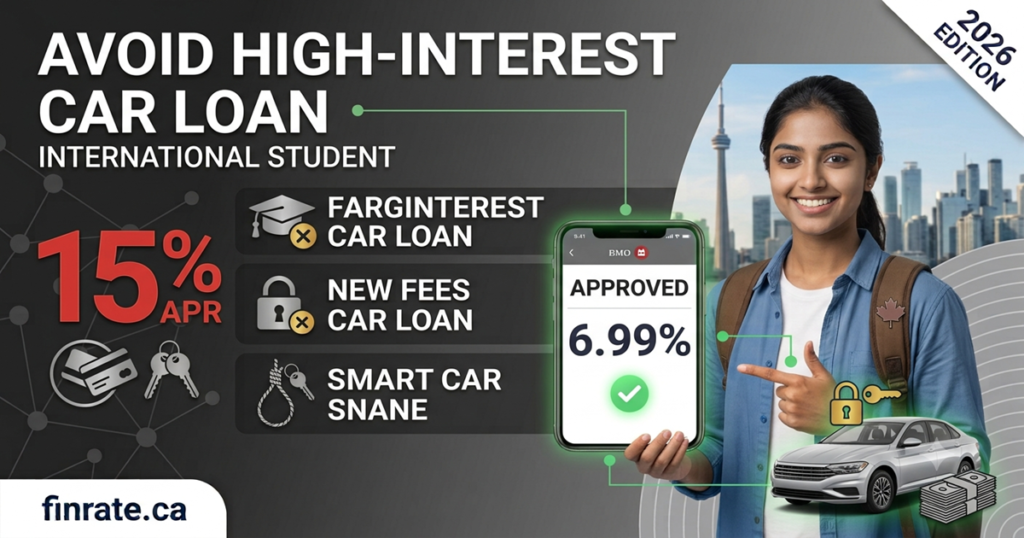
However, when you sit down in the finance manager’s office to sign the final paperwork, you see a terrifying number buried in the contract: An interest rate of 15%, 18%, or even 22%. Desperate for a vehicle, thousands of international students sign these predatory contracts every single year, unknowingly trapping themselves in thousands of dollars of unnecessary debt. In this comprehensive guide, we are going to expose exactly why dealerships target international students with high interest rates, the brutal math behind these loans, and the exact strategies you can use to secure fair financing.
Why Do Dealerships Charge Students 15%+ Interest?
To understand how to beat the system, you must first understand how the Canadian auto financing industry views you as a buyer. You are not being charged 18% interest simply because the dealership wants to be cruel; you are being charged that rate because the banks view you as a “Subprime” (high-risk) borrower.
Here is why international students and temporary residents fall into this high-risk category:
- The Temporary SIN: Your Social Insurance Number starts with a “9”. This immediately alerts the dealership’s computer systems that you are a temporary resident. Lenders view you as a “flight risk.” They worry that if you cannot pay the loan, you might simply abandon the car at the airport and fly back to your home country.
- Thin Credit Files: Even if you have never missed a payment on your $1,000 limit student credit card, your credit history in Canada is simply too short. You have what the industry calls a “thin file.” You have not proven that you can handle a massive $20,000 debt load over a period of five years.
- Part-Time Income: Standard auto lenders want to see proof of full-time, permanent employment with a regular salary. Working 20 hours a week at a retail job on a Study Permit does not provide enough income stability to satisfy a traditional bank.
Because traditional banks (like TD or RBC) will often reject your application, the dealership will send your file to “Alternative” or “Subprime” lenders. These lenders specialize in high-risk approvals, but they charge massive interest rates to cover their risk.
The Brutal Math: How a $15,000 Car Ruins Your Budget
Many dealership salespeople will use a very specific psychological trick to get you to sign a high-interest loan: They hide the total cost of the car by only talking about the monthly payment.
They will say, “Don’t worry about the interest rate! We got you approved for only $380 a month. That easily fits your part-time job budget!”
Let’s look at the mathematical reality behind that “affordable” monthly payment.
Assume you are buying a used car for $15,000 with zero down payment. The subprime lender gives you an 18% interest rate over a 72-month (6-year) term.
- Your Monthly Payment: $345
- Total Interest You Will Pay: $9,840
- Total Cost of the Car: $24,840
You are paying nearly $10,000 purely in interest fees. By the time you finish paying off the loan in six years, the car will be practically worthless due to depreciation, leaving you completely financially drained. This is the exact trap you must avoid.
4 Strategies to Finance a Car Properly in Canada
If you refuse to sign a 15% loan, how do you actually get a car? Here are four proven strategies international students and Post-Graduation Work Permit (PGWP) holders can use to get behind the wheel without getting scammed.
Strategy 1: Use “Newcomer” Banking Programs
Do not rely on the dealership to find a lender for you. Instead, go directly to the major Canadian banks. Many of the “Big Five” banks recognize that newcomers are highly profitable future clients, so they have created specialized Auto Finance programs that bypass the strict credit requirements.
- Scotiabank StartRight Program: Scotiabank is highly friendly to newcomers. If you have been in Canada for less than 3 years, you can often get approved for a car loan at standard rates (usually between 6% and 8%), even with a limited credit history.
- The Catch: These programs usually require you to buy the car directly from an authorized, franchised dealership (like an official Honda or Ford dealer), not a random used car lot on the side of the highway.
Strategy 2: The 25% Down Payment Shield
Lenders calculate risk based on “Loan-to-Value” (LTV). If you want to borrow 100% of the car’s price, you are a massive risk. If you can save up cash and offer a 20% to 25% down payment upfront, the lender’s risk drops dramatically.
By putting down a significant chunk of cash, you can often negotiate the dealership’s subprime lender down from 18% to a much more manageable 9% or 10%.
Strategy 3: The “Cash Beater” Method (The Smartest Choice)
The absolute best financial decision an international student can make is to completely avoid financing their first vehicle.
Instead of taking on debt for a shiny $15,000 car, save up $4,000 to $6,000 in cash. Use websites like Kijiji, AutoTrader, or Facebook Marketplace to buy an older, reliable “beater” car (like a 2010 Honda Civic or Toyota Matrix) directly from a private seller.
Crucial Safety Tip: If you buy a car privately with cash, you must pay an independent mechanic to do a “Pre-Purchase Inspection” (usually costs $100). Furthermore, ensure the seller provides a valid Safety Standards Certificate. You legally cannot put license plates on the car in provinces like Ontario without this certificate!
Strategy 4: Wait for Your PGWP and Full-Time Job
If you can survive public transit for the duration of your studies, wait until you graduate. The moment your status changes to a Post-Graduation Work Permit (PGWP) and you secure a full-time employment letter with a real salary, you transform from a “high-risk student” to a “prime borrower.” With a PGWP and a full-time job, traditional banks will eagerly approve you for standard, low-interest auto loans.
Dealership Red Flags: When to Walk Away
If you do decide to finance a car at a dealership, you must remain vigilant. If you see any of these red flags, get up and walk out of the office immediately:
- “We Finance Everyone!” Signs: Dealerships that advertise “No Credit, Bad Credit, New to Canada? 100% Approved!” are almost always predatory subprime lenders. They will approve you, but they will charge you 25% interest to do it.
- Refusing to Show the APR: The Annual Percentage Rate (APR) is your true interest rate. If the salesperson keeps avoiding your questions about the exact APR and only points to the bi-weekly payment amount, they are hiding a terrible interest rate.
- Forced Add-ons: Watch out for finance managers who try to secretly add “VIN Etching,” “Nitrogen Tires,” or overpriced “Extended Warranties” into the final loan amount. These are highly profitable scams that inflate your total debt. You have the legal right to decline all of these extras.
Frequently Asked Questions (FAQs)
Does my car loan need to end before my visa expires?
In most cases, yes. The vast majority of Canadian banks will not approve an auto loan term that extends past the expiration date printed on your Study Permit or Work Permit. If your PGWP expires in 3 years, the maximum loan term a prime bank will give you is 36 months.
Does paying a car loan improve my Canadian credit score?
Yes. An auto loan is considered an “Installment Loan.” If you make your monthly payments on time and in full every single month, it will drastically improve your Canadian credit score, proving to future lenders (like mortgage brokers) that you are highly responsible with large debts.
Do international students pay more for car insurance?
Yes, but not because of your immigration status. You pay more because you have zero driving history in North America. To lower your insurance premiums, ask your insurance provider in your home country to provide a “Letter of Experience” proving you have been driving safely for years. Many Canadian insurance companies will accept this letter and lower your monthly rates!
Take the Wheel Without the Debt
Getting your driver’s license and buying your first car in Canada should be a moment of absolute freedom, not the beginning of a financial nightmare.
By understanding how subprime interest rates work, utilizing newcomer banking programs, or simply saving up to buy a reliable older vehicle in cash, you can navigate the Canadian auto market safely. Remember, no car is worth ruining your financial future over!
(Are you about to graduate and start making full-time money? Don’t let your bank start charging you hidden fees! Read our complete guide on What Happens to Your Free Student Bank Account When You Get a PGWP? to protect your cash!)

1 thought on “How to Avoid the 15% Car Loan Trap as an International Student in Canada”