
When you move to Canada, you have to start all over with your financial history. It does not matter if you were a millionaire in your home country or if you had a perfect banking record for ten years before moving here. In the eyes of the Canadian financial system, you are essentially a “ghost.” Your financial reputation resets completely to zero.
Your Canadian credit score is like a permanent report card for how you manage your money. You need a strong credit score to do almost everything important in this country. Do you want to rent a nice apartment off-campus? The landlord will check your score. Do you want to finance a reliable used car to drive to your part-time job? The dealership will check your score. Eventually, when you want to buy a house, banks will use this exact three-digit number to decide if they will give you a mortgage.
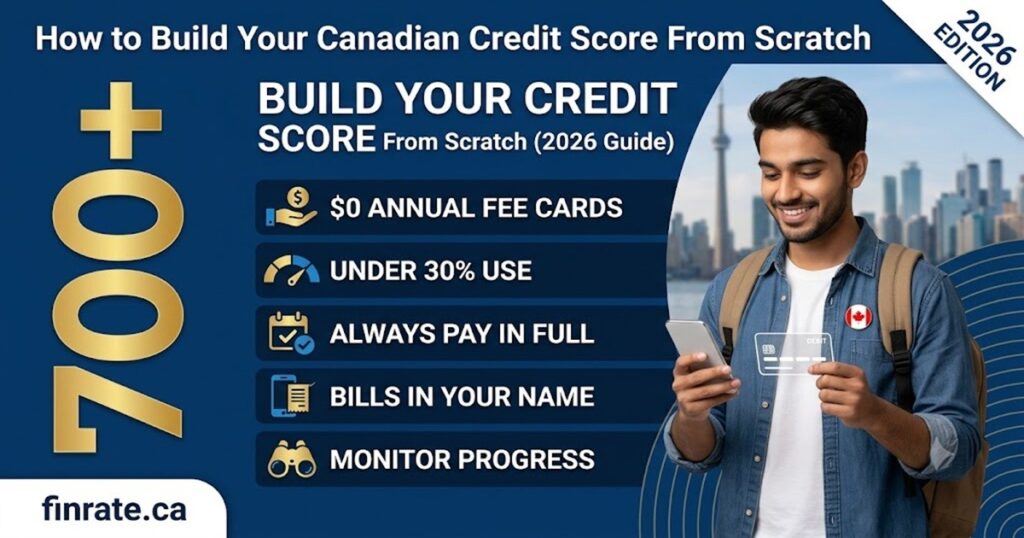
Building a solid credit score from scratch is not actually that hard, but you have to follow some very specific rules from the very beginning. One simple mistake in your first few months can take years to fix. Here is your ultimate, step-by-step guide to building a 700+ Canadian credit score quickly and safely.
What is a Canadian Credit Score?
Your credit score is a three-digit number that shows banks and lenders how responsible you are with borrowed money. In Canada, the government does not track your score. Instead, there are two major private companies, called credit bureaus, that calculate your credit score: Equifax and TransUnion.
Whenever you open a credit card or pay a phone bill, your bank reports your activity to these two companies. Your credit score can range anywhere from 300 to 900. Here is what those numbers actually mean for your life in Canada:
- 300 to 599 (Poor): If your score is in this range, lenders consider you a high risk. You will likely be rejected for most credit cards, auto loans, and apartment leases.
- 600 to 659 (Fair): You might get approved for certain loans, but banks will charge you a very high interest rate because they still do not fully trust your financial habits.
- 660 to 724 (Good): This is the baseline average for most Canadians. With a “Good” score, you can easily get approved for premium credit cards and standard auto loans.
- 725 to 759 (Very Good): Landlords will love you, and banks will start offering you lower interest rates on major loans.
- 760 to 900 (Excellent): You have mastered the Canadian financial system. You will get the fastest approvals and the lowest possible interest rates on mortgages.
When you first arrive in Canada, you do not start at 300; you simply do not have a score at all. Here is how to generate your first score.
Step 1: Get Your First Student or Secured Credit Card
You need a credit product to start building your credit score. You cannot use a regular debit card or physical cash to build your credit score because those methods only use your own money. Credit bureaus want to see how you handle borrowed money.
If you are an International Student:
You are in luck. Most major Canadian banks (like Scotiabank, CIBC, BMO, and TD) have special newcomer and student programs. You can apply for a student credit card right away. You do not need a job or a credit history to get approved. As long as you have a valid Study Permit, they will usually issue you a beginner credit card with a limit of $500 or $1,000.
If you are a Worker or Non-Student Newcomer:
If you are struggling to get approved for a standard credit card, you can apply for a Secured Credit Card. This type of card requires a security deposit. For example, you give the bank $500 of your own money as a deposit, and they give you a credit card with a $500 limit. If you use it responsibly for 6 to 12 months, the bank will graduate you to a regular “unsecured” card and return your original $500 deposit.
Step 2: Follow the 30% Credit Utilization Rule
Getting a credit card is the easy part. How you use it is what actually dictates whether your score goes up or down.
The biggest mistake newcomers make is maxing out their credit cards. If the bank gives you a $1,000 limit and you spend $950 of it every month, the credit bureaus think you are desperate for money, even if you pay it back on time. This is called your Credit Utilization Ratio, and it accounts for about 30% of your total credit score.
You should never spend more than 30% of your available credit limit at any given time.
- If your credit limit is $1,000, you should try your best not to let your statement balance go above $300.
- If your credit limit is $500, you should keep your balance below $150.
Pro Tip: What if you need to buy a $800 laptop for college, but your limit is only $1,000? You can still use your credit card to get the reward points. Just log into your mobile banking app the very next day and immediately transfer $600 from your chequing account to your credit card. This brings your balance back down to $200 (which is 20%), keeping your credit score safe.
Step 3: Never Miss a Due Date (Beware of Minimum Payments)
Your payment history is the single most important factor in the Canadian credit system. It makes up 35% of your total credit score. A single missed payment can stay on your Equifax and TransUnion reports for up to six years, severely damaging your financial reputation.
To master this step, you need to understand the difference between your Statement Date and your Due Date. Every month, the bank sends you a statement (a bill) summarizing what you spent. You usually have a 21-day Grace Period between the day the statement is generated and the day the money is actually due.
- Always pay your bill in full before the actual Due Date.
- Never fall into the “Minimum Payment” trap. Your bill might say you owe $300, but the minimum payment is only $10. If you only pay the $10, the bank will charge you a massive 20% to 22% interest rate on the remaining $290. Treat your credit card like a debit card: only spend money you already have sitting in your bank account, and pay 100% of the balance every month.
Step 4: Put Everyday Bills in Your Own Name
Your credit card is not the only thing that can help build your credit score. Many everyday utility bills and telecommunication contracts also report to the credit bureaus.
When you first arrive, you might be tempted to get a cheap prepaid phone plan (like Chatr or Lucky Mobile) or put the apartment’s Wi-Fi bill in your roommate’s name. This is a missed opportunity.
Try to get a “postpaid” monthly cell phone plan (like Fido, Koodo, or Virgin Plus) under your own name as soon as possible. Because the phone company gives you the service for a full month before asking you to pay the bill, they consider it a form of credit. Every time you pay your phone or home internet bill on time, it sends a positive signal to Equifax and TransUnion, helping to boost your score in the background.
Step 5: Avoid Too Many Hard Credit Checks
Every time you apply for a new credit card, an auto loan, or an apartment lease, the lender asks the credit bureau for a copy of your financial file. This is called a Hard Inquiry (or a Hard Pull).
Every hard inquiry temporarily drops your credit score by roughly 5 to 10 points. If you apply for five different credit cards in a single week because you want all the welcome bonuses, your score will crash, and banks will view you as financially unstable.
How to avoid this:
- Only apply for one beginner credit card when you first arrive.
- Do not accept store credit cards (like Walmart or Canadian Tire cards) at the checkout counter just to get a 10% discount on your groceries.
- Wait at least 6 months before applying for a second credit card or a limit increase.
How to Check Your Credit Score for Free
You should check your credit score every single month to see how you are progressing and to ensure no one has stolen your identity to open fake accounts.
Checking your own credit score is considered a Soft Inquiry. Unlike a Hard Inquiry, checking your own score will absolutely never hurt or lower your rating. You can check it as many times as you want.
You do not need to pay for this service. In Canada, you can check your score for free through:
- Your Mobile Banking App: Banks like Scotiabank, CIBC, and RBC provide your TransUnion score for free directly inside their apps.
- Third-Party Services: You can sign up for free, secure platforms like Borrowell (which shows your Equifax score) or Credit Karma (which shows your TransUnion score).
Frequently Asked Questions (FAQs)
How long does it take to get a good credit score in Canada?
If you get your first credit card, keep your utilization below 30%, and never miss a payment, it usually takes about 6 to 12 months to generate a “Good” credit score (around 660 to 680). Building an “Excellent” score (760+) usually takes a few years of consistent, responsible financial behavior.
Does debit card spending help my credit score?
No, debit card spending does not help your credit score at all. Debit cards use your own cash from your chequing account, so the credit bureaus do not track this activity. You must use a registered credit product to build a score.
Should I cancel my beginner credit card after I graduate?
No, you should never cancel your very first credit card, even if you get a much better premium card later on. The “Age of Credit History” is a major factor in your score. Lenders want to see that you have a long, reliable history of managing an account. Keeping your oldest, no-fee beginner card open forever helps anchor your credit history and keeps your score high.
Can my credit score drop if I do not use my card?
Yes. If you throw your credit card in a drawer and never use it for six months, the credit bureaus have no new data to evaluate your habits. This is called becoming “inactive,” and your score may slowly start to drop. To prevent this, simply put a small recurring subscription (like Netflix or Spotify) on the card and set it to auto-pay from your chequing account.
Start Your Financial Journey Right
Building a great credit score in Canada takes time, discipline, and patience. By understanding how the system works and following these five essential rules, you can easily build a solid 700+ credit score without ever paying a single dollar in bank interest.
Start by getting a student or secured credit card, strictly follow the 30% utilization rule, and always pay your bills in full before the due date. A strong credit score will open doors to better housing, cheaper auto loans, and a very bright financial future in Canada.
(Want to learn more about setting up your finances? Check out our guide on the [Top 5 No-Fee Student Chequing Accounts in Canada].)

2 thoughts on “How to Build Your Canadian Credit Score from Scratch (2026 Guide)”