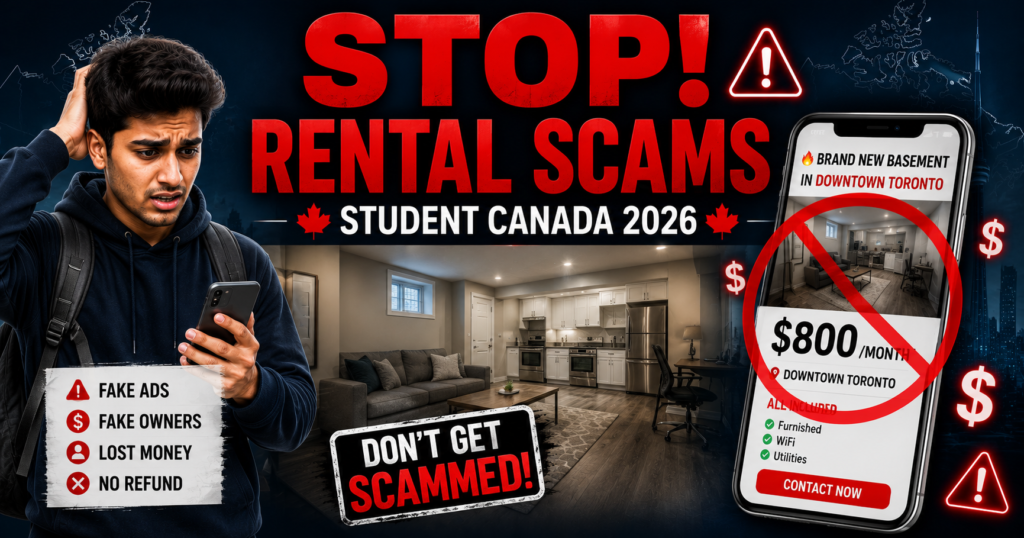
🚨 TL;DR (Quick Summary)
Finding a basement or room in Canada is highly competitive, making international students the perfect target for rental scams. The golden rule of renting in Canada: Never send an e-Transfer or wire money before you have physically viewed the property, met the landlord, and signed a standard provincial lease. Beware of landlords who claim to be “out of the country” or demand a deposit just to hold the viewing.
When you land in Canada, the excitement of starting a new life is quickly overshadowed by one massive challenge: finding a place to live. With high rent prices and low availability in cities like Toronto, Vancouver, and Calgary, students are desperate.
Scammers know you are desperate. They also know that as an international student, you probably do not understand Canadian rental laws. Every month, students lose their entire GIC savings to fake landlords on Kijiji and Facebook Marketplace.
In this guide, we will expose the most common rental scams targeting newcomers and give you the ultimate checklist to secure a safe, legal apartment in Canada.
The Top 3 Rental Scams Targeting Students
Before you start messaging people online, you need to know exactly how the scammers operate. If you see any of these three scenarios, run away immediately:
1. The “Out of Town” Landlord
This is the most common scam. You find beautiful pictures of a basement on Facebook Marketplace for an unbelievably low price (e.g., $800 for a 1-bedroom in downtown Toronto). When you message the landlord, they reply with a long, emotional story: “I am a missionary working in the UK right now, so I cannot show you the place in person. If you e-Transfer me the first and last month’s rent, I will courier the keys to you.” The Reality: The apartment doesn’t exist, or they stole the photos from a real estate website. If you send the money, they will block you, and you will never get your cash back.
2. The “Pay-to-View” Deposit
You message a landlord, and they tell you that there is extremely high demand for the room. They say, “To prove you are a serious tenant, you need to send a $200 good-faith deposit just to schedule a viewing. Don’t worry, it is fully refundable.”
The Reality: In Canada, it is completely illegal for a landlord to charge an application fee or a viewing fee. Real landlords will never ask for money just to open the door for you.
3. The Fake Airbnb Link
The scammer posts an ad and tells you that the transaction will be handled safely through Airbnb or TripAdvisor. They send you a link to book the room.
The Reality: The link is a sophisticated phishing website designed to look exactly like Airbnb. When you put in your credit card details, the money goes straight to the scammer.
4 Golden Rules for Safe Renting
To protect your hard-earned money, follow these strict rules every time you hunt for a rental:
Rule #1: Physical Viewing is Mandatory
Never sign a lease or send money without stepping foot inside the apartment. If you are still in your home country, book a temporary Airbnb or stay with family/friends for the first two weeks while you look for a permanent place in person.
Rule #2: Demand the Standard Lease
In provinces like Ontario, landlords are legally required to use the Ontario Standard Lease document. It is a government-issued form. If a landlord insists on writing their own rules on a blank piece of paper or refuses to give you a formal contract, walk away.
Rule #3: Protect Your Documents
Landlords are legally allowed to ask for your credit score (check out our guide on [How to Build a 750+ Credit Score Fast]) and proof of enrollment or income. However, they are not allowed to ask for a photograph of your Social Insurance Number (SIN) card. Protect your SIN with your life to avoid identity theft.
Rule #4: Set Up Tenant Insurance
Once you finally find a legitimate place and sign the lease, the landlord will ask for proof of Tenant Insurance. Do not panic! As we explained in our [Ultimate Guide to Tenant Insurance], it only costs about $15 a month and protects your laptop, phone, and belongings from theft or fire.
Where Should Students Actually Look for Housing?
Instead of relying on shady Kijiji ads, use these safer methods:
- Your College/University Housing Board: Most Canadian colleges have off-campus housing portals where local landlords are vetted by the school.
- Realtor.ca: This is the official database for Canadian real estate. Working with a licensed real estate agent to find a rental is completely free for you (the landlord pays the agent’s commission). This is the safest way to rent.
- Property Management Websites: Look for purpose-built rental buildings owned by large corporations (like Boardwalk or Capreit). You apply directly on their secure corporate websites, eliminating the risk of scammers.
Frequently Asked Questions (FAQs)
Can a landlord ask for 6 months of rent upfront?
Legally, no. In most provinces (like Ontario and BC), a landlord can only legally ask for the First and Last month’s rent as a deposit. However, because international students have no Canadian credit history, many students voluntarily offer to pay 3 to 6 months upfront to beat the competition.
What is a damage deposit?
Rental laws vary by province. In British Columbia and Alberta, landlords are allowed to ask for a security/damage deposit (usually half a month’s rent). In Ontario, damage deposits are completely illegal.
Should I pay rent in cash?
It is highly recommended to pay your rent via Interac e-Transfer or post-dated cheques. This creates a permanent paper trail. If you must pay in cash, you legally have the right to demand a signed, written receipt from the landlord every single month.
Final Thoughts
The Canadian rental market is tough, but losing $2,000 to a scammer is much worse. Trust your instincts. If a deal looks too good to be true, it is a scam. Take your time, view the property in person, sign the legal paperwork, and start your Canadian journey safely.