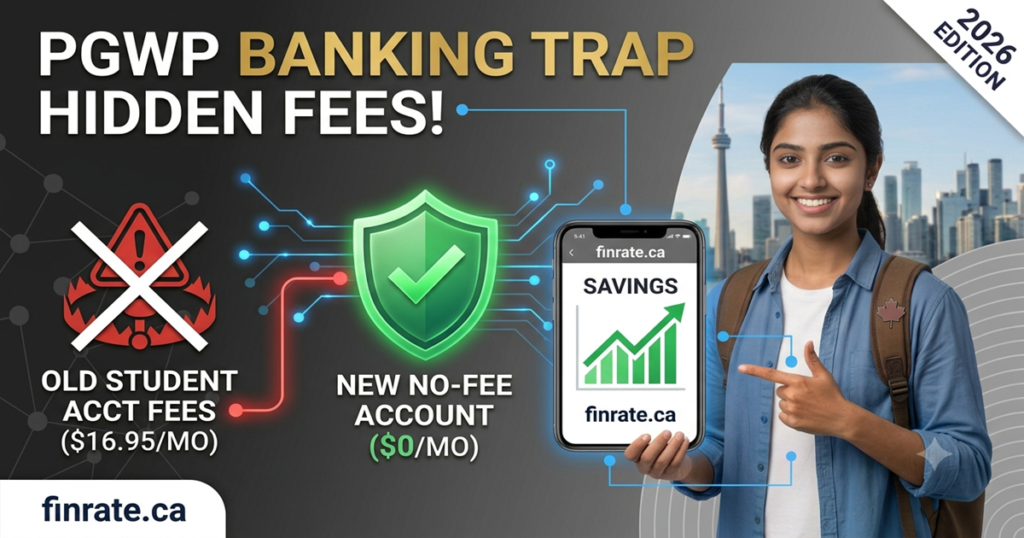
You did it. After years of stressful assignments, expensive tuition, and working part-time in the freezing Canadian winter, you have finally graduated. You successfully applied for your Post-Graduation Work Permit (PGWP) and landed your first real, full-time professional job.
Everything feels perfect until you check your mobile banking app at the end of the month. Right there, buried under your grocery and transit transactions, is a strange deduction: Monthly Maintenance Fee – $16.95.
You immediately call your bank, confused. You tell the customer service representative, “I have a student account, I am not supposed to pay any monthly fees!” The representative politely replies, “Congratulations on your graduation! However, our system shows your student status has expired. Your account has been automatically upgraded to an Adult Everyday Chequing Account.”
Welcome to the PGWP Banking Trap.
For years, Canadian banks gave you a VIP pass to free banking. But they didn’t do it out of charity; they did it because they know that once you graduate and start making a real salary, you will likely be too busy (or too lazy) to change banks. In this guide, we are going to expose exactly how this transition works, how to protect your money, and the exact steps you need to take the moment your student visa expires.
The Expiry Date You Didn’t Know You Had
When you first landed in Canada and opened your bank account using your Letter of Enrollment, the bank teller entered an “Expected Graduation Date” into their computer system.
The bank’s software is completely automated. The very day that date passes, your account is stripped of its “Student” classification. Without any warning or special phone call, your account is converted into a standard chequing account.
Suddenly, you are being charged for the very things that used to be free:
- $10 to $17 per month just to keep the account open.
- $1.00 to $1.50 for every Interac e-Transfer you send.
- Limits on how many debit transactions you can make per month.
Over the course of a 3-year PGWP, these fees can easily drain over $600 from your hard-earned savings.
3 Strategies to Beat the PGWP Trap
You do not have to accept these fees. You have full control over your money. Here are the three best strategies to keep your banking absolutely free as a young professional in Canada.
Strategy 1: The “Minimum Balance” Shield
If you absolutely love your current bank (like Scotiabank, RBC, or TD) and refuse to leave, there is a legal loophole to waive the monthly fee.
Most “Big Five” banks have a minimum balance waiver policy. If you keep a specific amount of money untouched in your chequing account at all times, they will waive the $16.95 fee. For a standard tier account, this minimum balance is usually $3,000 or $4,000.
- The Catch: If your balance dips to $2,999 for even a single minute during the month, you will be charged the full fee. Furthermore, leaving $4,000 sitting in a chequing account means you are losing out on the interest that money could be earning in a High-Interest Savings Account (HISA).
Strategy 2: Negotiate a “Graduate” or “Newcomer” Package
Before giving up on your bank, walk into a physical branch and negotiate.
Many major banks offer a “Recent Graduate Program” that extends your free banking for an additional 6 to 12 months after you finish school.
Alternatively, if you have been in Canada for less than 3 to 5 years (depending on the bank), you might still qualify for their “Newcomer to Canada” package, which also provides free banking. Bring your PGWP document to the branch and ask the teller to apply one of these promotional codes to your profile.
Strategy 3: The Ultimate Fix — Switch to a Digital Bank
This is the strategy that financial experts highly recommend. Once you graduate, you no longer need the physical branches that were so helpful during your GIC payout days. You are ready for a purely digital ecosystem.
Banks like Tangerine (owned by Scotiabank) and Simplii Financial (owned by CIBC) offer premium, no-fee chequing accounts with absolutely no minimum balance requirements.
- The Benefits: Zero monthly fees forever, unlimited free Interac e-Transfers, and free access to massive ATM networks (Tangerine users can use any Scotiabank ATM; Simplii users can use any CIBC ATM).
- The Reality: Making the switch takes about 15 minutes online. Do not let “bank loyalty” cost you hundreds of dollars.
What About My Student Credit Card?
While you should absolutely ditch your student chequing account if it starts charging fees, DO NOT cancel your student credit card.
The length of your credit history accounts for 15% of your Canadian credit score. If you cancel your very first credit card, your credit score will drop significantly, which will hurt your chances of getting a car loan or a mortgage.
Instead, call your bank and ask for a “Product Transfer.” Tell them you are now working full-time on a PGWP and want to upgrade your basic student card to a premium Cash-Back or Travel Rewards card. They will upgrade the physical card and give you better rewards, but they will keep your original account number and credit history completely intact!
Evolve Your Finances
Graduating and securing your PGWP is the moment you officially transition from a temporary student to a permanent part of the Canadian economy. Your financial strategies need to evolve with you.
Check your banking app today. Find out exactly what day your student status expires, and make a plan. Whether you decide to maintain a minimum balance or make the smart switch to a digital bank, never pay a monthly fee for your own money!
(Now that your everyday banking is sorted, it is time to maximize your savings. Read our updated guide on the Best Student Savings Accounts in Canada to make sure your extra cash is earning the highest interest possible!)
Frequently Asked Questions (FAQs)
Yes. If your bank asked for a copy of your work permit when you updated your file, they have the expiry date on record. However, standard adult accounts do not expire like student accounts do, so your day-to-day banking will continue normally even as you transition to Permanent Residency (PR).
If you switch to Tangerine or Simplii, you will need to manually update your payment info. You must provide your new “Void Cheque” or Direct Deposit form to your employer for your payroll, and update your new banking details for your gym membership, phone bill, and credit card auto-payments.
Yes! If you finish a 1-year certificate and immediately enroll in another program, simply take your new Letter of Enrollment to the bank. They will update your expected graduation date, and your free student banking status will continue uninterrupted.
The best bank for a Post-Graduation Work Permit in Canada is usually a digital bank like Tangerine or Simplii Financial. Since PGWP holders no longer need frequent in-branch services like GIC payouts, switching to a digital bank guarantees zero monthly fees, unlimited e-Transfers, and free daily banking.
To avoid bank fees after graduation in Canada, you have three main options: maintain a high minimum daily balance (usually $3,000+) in your current account, ask your bank to apply a temporary 1-year “Recent Graduate” or “Newcomer” promotional package, or permanently switch your banking to a no-fee digital institution.
When comparing Tangerine vs Simplii for PGWP workers, both are excellent no-fee options. Tangerine (owned by Scotiabank) offers a slightly better mobile app experience and customizable cash-back credit cards. Simplii Financial (owned by CIBC) is fantastic for those who frequently use CIBC ATMs and send international wire transfers.