
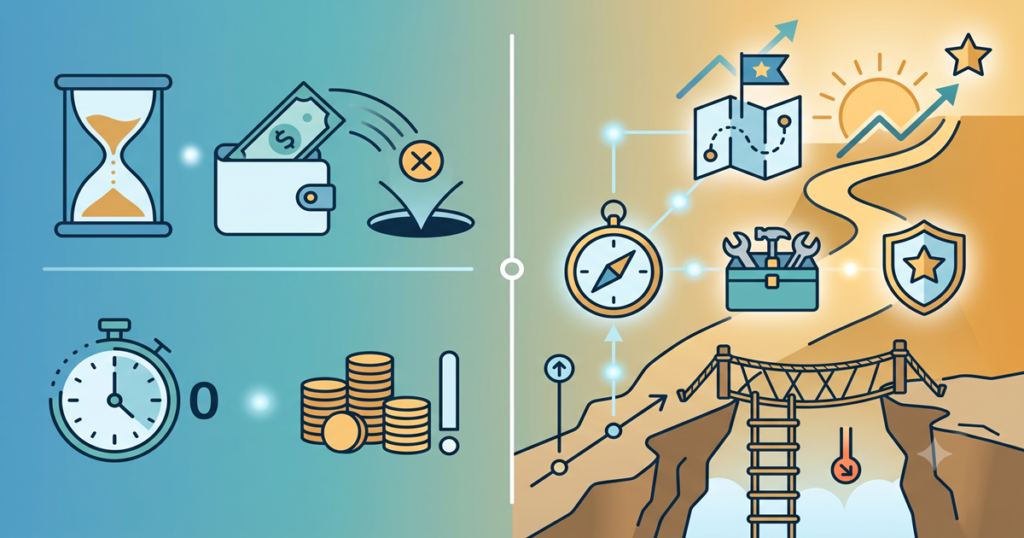
The first twelve months as an international student in Canada are an absolute whirlwind. You are constantly juggling a hundred different experiences at once: making difficult cultural adjustments, passing your first-semester midterms, surviving your first brutal Canadian winter, and trying to figure out the local transit system.
But throughout this chaotic first year, you have had one massive financial safety net catching you at the end of every single month: your Guaranteed Investment Certificate (GIC).
Whether you arrived under the older rules and received roughly $670 a month, or you came under the new IRCC guidelines and get around $1,375 every month, that automatic deposit into your chequing account is a lifesaver. It acts like a guaranteed monthly salary. It pays your portion of the rent, it covers your phone bill, and it ensures you have enough money to buy groceries when your part-time job hours get cut during exam season.
But then, Month 13 arrives.
You wake up, open your mobile banking app expecting to see your usual payout, and your balance has not moved. The well has officially run dry. Your final GIC installment was paid out last month, your account is empty, and you are now entirely on your own for the rest of your academic journey in Canada.
Among the international student community, this sudden, terrifying drop in income is infamously known as the “Year 2 Cliff.” If you do not prepare for it ahead of time, the financial shock can severely disrupt your studies, force you into credit card debt, and take a massive toll on your mental health.
In this comprehensive guide, we are going to walk you through exactly how to prepare for the end of your GIC, how to aggressively replace that lost income, and how to successfully transition into a financially independent adult in Canada.
The Reality Check: What Actually Changes in Year 2?
To survive your second year, you have to take a hard, honest look at what is coming. When your GIC ends, your monthly living expenses do not magically disappear. In fact, they usually increase.
Here is the financial reality you are facing in Year 2:
- Zero Guaranteed Income: You will no longer receive an automatic monthly deposit to cover your base living expenses. Every dollar you spend must now be earned through your own labor.
- The Tuition Reality: The money you brought from your home country likely only covered your first two semesters. In Year 2, you are entirely responsible for generating the cash to pay your international tuition fees—which can easily range from $8,000 to $10,000 per semester.
- Inflation and Rent Increases: The cost of living in Canada rarely goes down. Landlords are legally allowed to increase your rent every 12 months (following provincial guidelines). The groceries that cost you $200 a month when you landed might now cost $250.
Do not panic. Hundreds of thousands of international students hit this exact same wall and make it through successfully every single year. The secret is that they do not wait until Month 13 to figure it out. You need to start preparing at least 90 days before your final GIC payout.
Step 1: The 90-Day Transition Plan (Months 10 to 12)
You cannot wait until your GIC is completely gone to start worrying about money. You must use the final three months of your GIC schedule to build a financial bridge to your second year.
Audit Your Spending ruthlessly
Open your banking app and look at your past 60 days of transactions. Calculate exactly how much money you spend in a typical month. Separate your absolute “Needs” (Rent, Groceries, Utilities, Presto/Transit Card) from your “Wants” (UberEats, weekend movies, expensive coffees). You need to know your exact “survival number”—the minimum amount of cash you need just to stay alive and housed for 30 days.
Build a Mini-Emergency Fund
When Month 11 and Month 12 roll around, do not spend those final GIC payouts on a vacation, designer clothes, or a new iPhone. Take at least 50% of your final two payouts and transfer them into a separate High-Interest Savings Account (HISA). This will give you a cash buffer of around $1,000 to $1,500. When your GIC ends, having this emergency fund will prevent you from panicking if your work hours get cut.
Downsize Your Bills
Since your income is about to drop, your fixed expenses must drop too. Call your cell phone provider (like Fido or Koodo) and ask for a cheaper, data-only student plan, or switch to a discount carrier like Public Mobile. Cancel subscription boxes you do not use. If your rent is eating up more than 50% of your income, it might be time to start looking for a cheaper room to rent before your current lease expires.
Step 2: Income Replacement Strategies
Once the GIC is gone, your part-time job becomes your primary lifeline. If you spent your first year working a minimum-wage survival job (like packing boxes in a warehouse or working a fast-food drive-thru) just to get by, Year 2 is the time to optimize your income.
Upgrade Your Employment
Working 20 hours a week at minimum wage (around $16.55 to $17.30 depending on your province) will barely cover your rent and groceries in major cities like Toronto, Calgary, or Vancouver. It is time to leverage the “Canadian Experience” you gained in Year 1. Update your resume and apply for jobs that pay slightly above minimum wage, such as bank tellers, administrative assistants, or specialized retail roles (like tech or cellular sales, which often include commission).
Seek Out Tips and Gratuities
If you are working in the hospitality industry, you need to move away from fast-food chains where tipping is rare. Get your provincial alcohol serving license (like Smart Serve in Ontario) and apply to full-service, sit-down restaurants or premium bars. Servers and bartenders in Canada can easily make an extra $100 to $200 a night in cash tips, which will drastically boost your monthly income without requiring extra hours.
Secure a Co-op or Paid Internship
If your college program includes a mandatory Co-op term, this is your golden ticket. Co-op jobs are legally considered an essential part of your academic program, which means you can often work full-time hours (40 hours a week) during that semester. Not only does this provide a massive income boost to help pay your Year 2 tuition, but it also gives you highly valuable, degree-related Canadian work experience to put on your resume.
Look for Campus Employment
Check your university or college job board relentlessly. Jobs on campus (like working at the front desk of the library, being a Teaching Assistant, or working for the student union) usually pay better than off-campus jobs. More importantly, they are highly flexible around your class schedule and save you money and time on commuting.
Step 3: Master the “Zero-Based” Student Budget
Without the safety net of a GIC, you must become incredibly strict with your cash flow. You can no longer just tap your debit card and hope you have enough money left over for rent. You need to adopt a “Zero-Based Budget.” This means every single dollar you earn from your part-time job must be assigned a specific purpose the moment it hits your account.
- The Rent Envelope: The moment your bi-weekly paycheque clears, immediately calculate your rent portion and transfer it into a separate savings account. Do not leave it in your everyday chequing account where you might accidentally spend it on a weekend out.
- The Grocery Envelope: Set a strict monthly limit (for example, $250 a month). Shop strictly at discount supermarkets like No Frills, Food Basics, or FreshCo. Take advantage of “Student Discount Days” (usually Tuesdays or Wednesdays) where stores offer 10% off if you show your student ID. When your $250 grocery budget is gone, it is gone. You eat pasta, rice, and beans until the next month.
- The Tuition Envelope: You must save aggressively for your next semester’s fees. If your tuition is $8,000 per semester, and you have four months to save for it, you need to be putting away a massive portion of your income specifically for the college.
Crucial Financial Tip: Most colleges and universities have a Student Food Bank specifically designed to help international students who are struggling to buy groceries. There is absolutely no shame in using these resources. If using the campus food bank saves you $150 a month, that is $150 you can put directly toward your tuition fees.
Step 4: Use Credit Cards Safely as a Shield
In your first year, you likely opened a student credit card to start building your Canadian credit score. In Year 2, that credit card becomes an essential financial tool—but it can also become a massive trap if used incorrectly.
If you have a gap of three days between your rent being due and your paycheque arriving, your credit card can bridge that gap. However, you must pay the balance off entirely before the 21-day grace period ends.
Do not fall into the minimum payment trap. If you start using your credit card to fund a lifestyle you can no longer afford because your GIC ended, the 21% interest rates will bury you in debt. Use your credit card only for fixed, planned expenses (like your phone bill or scheduled groceries) that you already have the physical cash in your chequing account to pay off.
Step 5: Use Credit Cards Safely as a Shield
In your first year, you likely opened a student credit card to start building your Canadian credit score. In Year 2, that credit card becomes an essential financial tool—but it can also become a massive trap if used incorrectly.
If you have a gap of three days between your rent being due and your paycheque arriving, a good cash-back credit card (like the BMO CashBack Mastercard for Students) can bridge that gap while earning you points on groceries.
However, you must pay the balance off entirely before the 21-day grace period ends. Do not fall into the minimum payment trap. If you start using your credit card to fund a lifestyle you can no longer afford because your GIC ended, the 21% interest rates will bury you in debt. Use your credit card only for fixed, planned expenses that you already have the physical cash in your chequing account to pay off.
Frequently Asked Questions (FAQs)
Can I renew or extend my GIC for a second year?
No, you cannot. The Student Direct Stream (SDS) GIC is strictly a one-year program designed by the Canadian government to ensure you survive your initial transition period in a new country. Once the 12 months are over and the funds are fully disbursed to you, the GIC contract is permanently closed. You cannot “buy” another student GIC.
Do I need to show another GIC to get my Post-Graduation Work Permit (PGWP)?
No, you do not. A GIC is only required for your initial Study Permit application when you apply from your home country. When you eventually graduate and apply for your PGWP, you are not required to purchase a new GIC or show a massive bank balance, because the government expects you to enter the Canadian workforce immediately.
What happens if I cannot afford my Year 2 tuition without my GIC?
This is a very stressful, but common, reality for many students. If you realize you cannot make your tuition deadline, do not ignore the college’s emails. Go immediately to your school’s International Student Financial Aid office. Many colleges offer emergency bursaries, international student scholarships, or structured payment plans that allow you to pay your tuition in smaller monthly installments rather than a massive, impossible lump sum.
Does my bank account start charging monthly fees when the GIC ends?
Generally, no. Your free student chequing account is tied to your status as a full-time student, not to your GIC. As long as you remain officially enrolled in college or university, your monthly banking fees should remain at $0. However, always check your specific bank’s terms to ensure your student status is up to date in their system.
Welcome to Total Financial Independence
The end of your Guaranteed Investment Certificate might seem incredibly scary right now, but it is actually a massive personal milestone. It forces you to take the training wheels off and learn how to manage a real, adult budget in Canada.
By taking a strict inventory of your expenses, strategically upgrading your part-time income, claiming your government tax benefits, and budgeting your money with military precision, you will not only survive the “Year 2 Cliff,” but you will emerge with the powerful financial habits needed to succeed long after you graduate!

1 thought on “What Happens When Your 1-Year GIC Payouts End? (The Year 2 Survival Guide)”