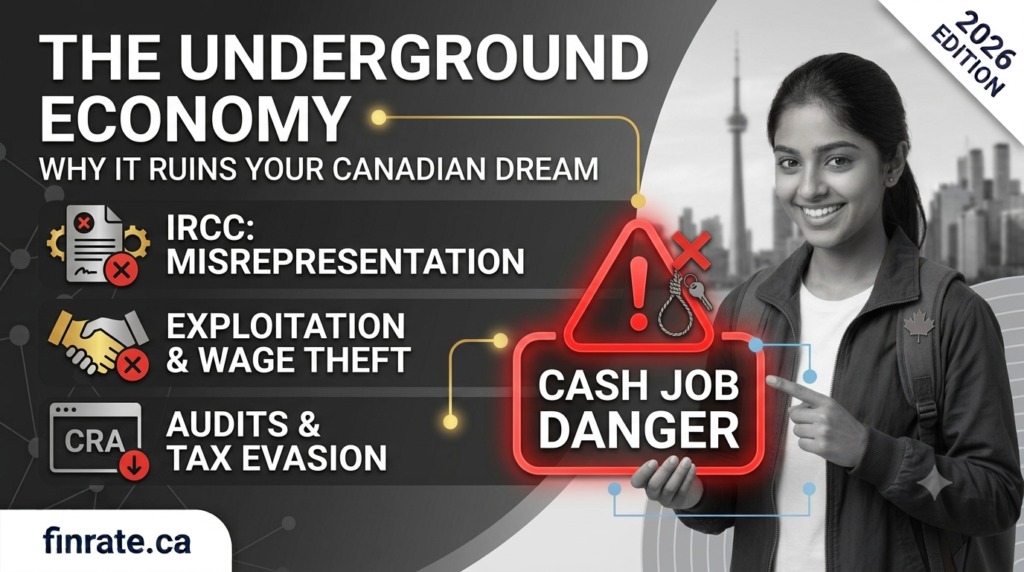
You have just arrived in Canada. Your rent is $1,000 a month, your groceries are incredibly expensive, and you are desperately trying to balance your college assignments. You know that as an international student, your Study Permit strictly limits how many hours you can work off-campus (historically 20 hours, recently adjusted to 24 hours per week by IRCC).
But 24 hours at minimum wage is barely enough to survive in cities like Toronto or Vancouver.
Then, a friend or a local business owner makes you an offer that sounds like a lifeline: “Come work for me in the kitchen or on the construction site. I will pay you in pure cash. No taxes, no government tracking, and you can work 40 hours a week without IRCC ever finding out.”
This is known as working “under the table.” In the moment, it feels like a massive win-win situation. You get extra money to pay your tuition, and the employer gets cheap labor.
However, accepting a cash job is the single most dangerous decision you can make as an international student in Canada. In this comprehensive guide, we are going to expose the dark reality of the underground economy, how the Canadian government actually tracks your money, and why working for cash is a guaranteed way to destroy your chances of getting a Post-Graduation Work Permit (PGWP).
The Illusion of “Untraceable” Money
The biggest myth among international students is that cash is completely invisible to the Canadian government. Newcomers often believe that if there is no official T4 tax slip and no direct deposit into their bank account, the Canada Revenue Agency (CRA) and Immigration, Refugees and Citizenship Canada (IRCC) are completely blind to the transaction.
This is fundamentally false. You live in a highly digitized, first-world economy. The government does not need to catch you holding physical dollar bills to know you are working illegally; they just have to look at the math of your digital life.
The Digital Trail You Leave Behind
Think about how you spend money in Canada:
- Your Rent: You likely pay your landlord $1,000 via Interac e-Transfer every month.
- Your Tuition: You pay your college $8,000 a semester via a bank draft or credit card.
- Your Remittances: You send money back to your home country using apps like Wise or Remitly.
If your only legal, declared income is a 20-hour-a-week job at Tim Hortons making $1,400 a month, but your bank statements show you spending $2,500 a month, the math does not add up. If the CRA or IRCC decides to audit your file, their automated systems will immediately flag this discrepancy. They will ask you to prove exactly where the extra $1,100 a month came from. If you cannot provide a legal paper trail, they will assume you are working illegally.
The Immigration Disaster (PGWP Rejection)
The ultimate goal for almost every international student is to graduate, secure a Post-Graduation Work Permit (PGWP), and eventually apply for Permanent Residency (PR).
Working for cash puts a massive target on your back during the PGWP application process.
When you apply for your PGWP, IRCC officers conduct a thorough review of your time in Canada to ensure you complied with all the conditions of your Study Permit. If they have any suspicion that you worked more than your legally allowed off-campus hours, they can request your detailed CRA tax records and bank statements.
If IRCC discovers that you worked illegally for cash to bypass the hour limits, the consequences are devastating and immediate:
- Your PGWP will be categorically denied.
- You may be issued an Exclusion Order (Deportation).
- You will be banned from re-entering Canada for up to 5 years for misrepresentation.
Do not risk a $100,000 Canadian education and your family’s future for an extra $500 of illegal cash from a sketchy employer.
The CRA Audit and Tax Evasion
Working for cash without declaring it on your annual tax return is not just a breach of your immigration status; it is a federal crime known as Tax Evasion.
If you take your illegal cash and try to deposit large amounts of it into your Canadian bank account (e.g., depositing $2,000 in physical bills into an ATM), you will trigger the bank’s Anti-Money Laundering (AML) software. Canadian banks are legally required to report suspicious cash deposits to FINTRAC (the government’s financial intelligence agency).
If the CRA audits you and finds undeclared cash income, they will hit you with terrifying penalties. You will be forced to pay the original taxes you owe, plus a massive penalty (often 50% of the tax owed), plus daily compounding interest. A simple cash job can quickly turn into thousands of dollars of debt owed to the federal government.
Severe Workplace Exploitation
When you agree to work “under the table,” you surrender all of your legal rights as a worker in Canada. Predatory employers specifically target international students because they know you are too scared of deportation to report them to the authorities.
Here is what happens when you work a cash job:
- Wage Theft: Cash employers routinely pay far below the provincial minimum wage. If the minimum wage is $17.00, they might only offer you $11.00 an hour.
- No Overtime or Holiday Pay: You will not receive legally mandated overtime pay (1.5x your hourly rate) or statutory holiday pay.
- No WSIB (Worker’s Compensation): This is the most dangerous aspect. If you are working legally and you accidentally cut your hand in a restaurant kitchen or fall off a ladder at a construction site, the government covers your medical bills and pays your lost wages. If you are working for cash and get injured, the employer will simply tell you to go home. You will be entirely responsible for your own medical bills, and you will have zero income while you recover.
How to Make Money Legally Instead
If you are struggling financially, there are entirely legal ways to increase your income without jeopardizing your visa.
- On-Campus Employment: Your off-campus work hour limits generally do not apply to jobs located strictly on your college or university campus. You can work as a Teaching Assistant, library clerk, or campus barista for extra hours legally.
- Paid Co-op Programs: If your academic program includes a mandatory Co-op or internship component, you can apply for a Co-op Work Permit. This allows you to work full-time (40 hours a week) during your scheduled work term.
- Upskill Your Part-Time Job: Instead of working 40 hours illegally at $12/hr, upgrade your skills to work 20 hours legally at $25/hr. Get your security guard license, become a certified forklift operator, or work premium hospitality shifts where you earn legally declared cash tips!
Frequently Asked Questions (FAQs)
Are cash tips illegal in Canada?
No! Earning cash tips as a server, bartender, or delivery driver is 100% legal. However, you must declare those tips as income when you file your taxes in April. As long as you report the tips to the CRA, you are completely safe.
What if an employer forces me to accept cash?
If a business owner refuses to put you on an official payroll (give you a T4 slip) and insists on paying you under the table, you should respectfully decline the job and look elsewhere. If you are already in this situation and they are refusing to pay you your earned wages, you can anonymously report them to your province’s Ministry of Labour.
Can the CRA actually talk to IRCC?
Yes. Historically, government departments were heavily siloed and did not share much data. However, in recent years, the Canadian government has vastly improved data-sharing agreements between the CRA, IRCC, and the Canada Border Services Agency (CBSA) specifically to combat immigration fraud and tax evasion.
Protect Your Canadian Dream
The underground economy is a trap designed to exploit the financial desperation of newcomers. While working for cash might provide a temporary solution to your rent problems, the long-term risks of tax audits, physical injury without insurance, and permanent deportation are absolutely not worth it.
Stay within your legal working limits, file your taxes honestly every year, and protect your Canadian dream!
(Are you struggling to survive strictly on your legal part-time income? Managing your money is all about strategy. Read our complete guide on [The “Zero-Based” Student Budget (Year 2 Survival Guide)] to stretch every legal dollar you earn!)